A tiger eye bracelet is a strand of chatoyant quartz — beads that flash a moving band of light as they turn, like a cat’s eye in the dark. The stone is quartz threaded with parallel fibres of crocidolite, and that fibre structure is what produces the shimmer. It is also the easiest of the “masculine” gemstones to wear: brown, gold and grey tones that sit beside denim, leather, silver or plain white cotton. This guide covers what the stone is, why some strands are heated or dyed, how to style it, and how to tell a good strand from a dull one.
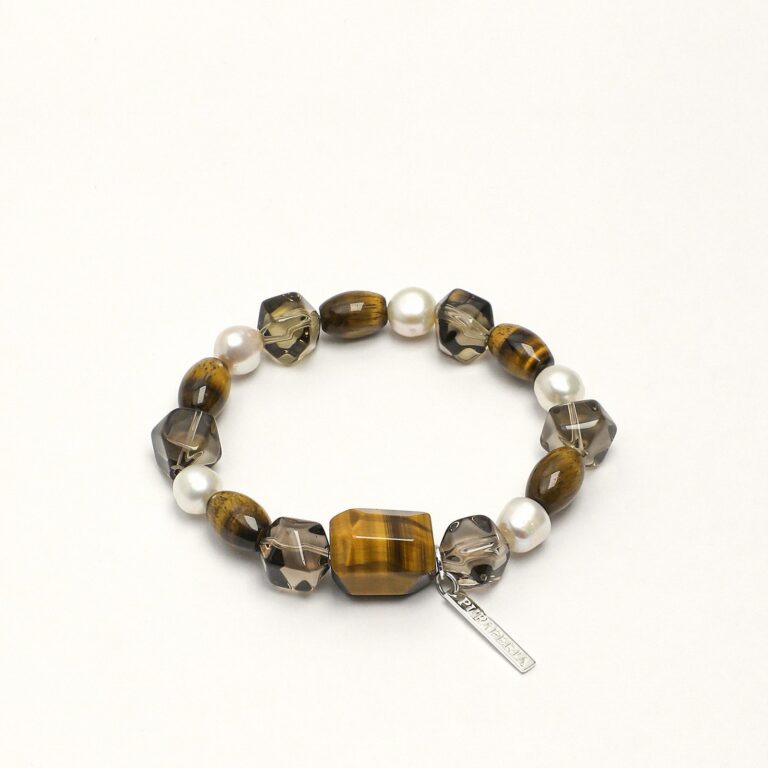
Golden tiger eye, hand-strung on a gold cord. Each strand bands differently — no two beads flash at the same point.
What tiger eye actually is
Tiger’s eye is a variety of quartz. The original material was crocidolite, a blue-grey asbestos mineral; over millions of years, silica replaced the fibres while keeping their alignment. What is left is quartz with millions of parallel channels inside it. Light enters those channels and reflects off them in one direction, which is the flash jewellers call chatoyancy — the same optical effect as a cat’s eye, and the reason the stone is sometimes sold as cat’s eye quartz.
That structure explains the practical behaviour. Tiger’s eye ranks 6.5–7 on the Mohs scale, hard enough for daily wear on a wrist but not hard enough to shrug off a scrape against a diamond or a ceramic tile. It is also why the stone is so rarely uniform: the fibre bands sit at slight angles from bead to bead, so two beads from the same strand will not flash at exactly the same point. That is normal, and it is the quickest way to tell a real strand from a printed imitation.
Main commercial sources are South Africa, which supplies most of the golden material, plus Australia and India. The stone is inexpensive relative to its visual impact, which is why it turns up so often in men’s beaded bracelets and in unisex stacks.
The three colours, and what they really are
Bead strands are sold in three main tones, and the trade is not always straight about where they come from.
— Golden / yellow-brown. The natural, unaltered colour. Warm honey through to dark bronze, with a bright silky band. This is the classic tiger eye and the safest buy.
— Red. Almost always heat-treated golden material; heating pushes the iron oxides toward red. Heat treatment is a stable, industry-standard process rather than a dye, but it is still a treatment and a listing should say so.
— Blue. Natural blue-grey material is hawk’s eye, the unoxidised form of the same fibre structure. Bright, saturated blue beads sold cheaply are usually dyed. If a strand is vivid cobalt, assume dyed unless the seller states otherwise.
One note on grading: “AA” and “AAA” on tiger eye are seller conventions, not an official scale. What actually matters is the strength of the flash, whether the bright band moves cleanly across the bead, and whether the surface is free of dull grey patches where the fibres have weathered.
What it is traditionally associated with
Tiger’s eye has a long folk history. In South African tradition it was carried as a protective stone; in nineteenth-century European lore it was worn to steady the nerves before a difficult decision, and it picked up an association with courage and clear sight because of the eye-like flash. Those are cultural traditions rather than medical claims, and they are worth knowing because buyers ask about them constantly.
If that framing matters to you, treat it as a ritual: a stone you put on before a meeting or a hard conversation, the way some people wear a watch their grandfather gave them. Tiger’s eye is traditionally associated with confidence and grounding, and believed by some to support focus. What it does reliably do is catch light in a way almost no other affordable stone does, which is a real, daily pleasure.
Worth saying plainly: these are natural stone beads, and each piece is unique in banding, tone and flash. No two strands match exactly, and that is the point.
How to style a tiger eye bracelet
Tiger eye is the easiest stone to wear with a wardrobe that has no jewellery in it. From a distance it reads as metal-adjacent — warm, slightly industrial — so it works where a gold bangle would feel like too much and a fabric bracelet would feel like too little.
| Tone | Pairs with | Metal |
|---|---|---|
| Golden / honey | Denim, tan leather, olive, cream, camel | Warm gold, brass |
| Deep bronze | Black, charcoal, navy, burgundy | Gold or silver |
| Red / heat-treated | Rust, terracotta, black denim, forest green | Silver, gunmetal |
| Blue / hawk’s eye | Grey tailoring, white shirts, slate, cool navy | Silver, steel |
| Mixed beads | Most things, but loud — one piece at a time | Match the dominant bead |
Three rules cover almost every case.
— One wrist, one statement. If you wear a metal watch, put the bracelet on the other wrist. Two metallic-lustre objects side by side compete, and neither wins.
— Stack by texture, not colour. Tiger eye next to matte black onyx or a plain silver chain looks deliberate; tiger eye next to another chatoyant stone looks like a bead shop display. Our silver and minimal pieces are the easiest partners for this.
— Go bigger than you think. Tiger eye beads under 6 mm disappear against a sleeve. Most men’s strands sit at 8–10 mm and most women’s at 8 mm; a 6 mm strand is a delicate piece, not a daily one.
For colour-based shopping, start with the tiger eye collection, which groups the darker bronze and mixed strands. If you want one bracelet that works with everything from a t-shirt to a blazer, deep bronze is the safe answer; golden honey is the more summer-friendly choice.
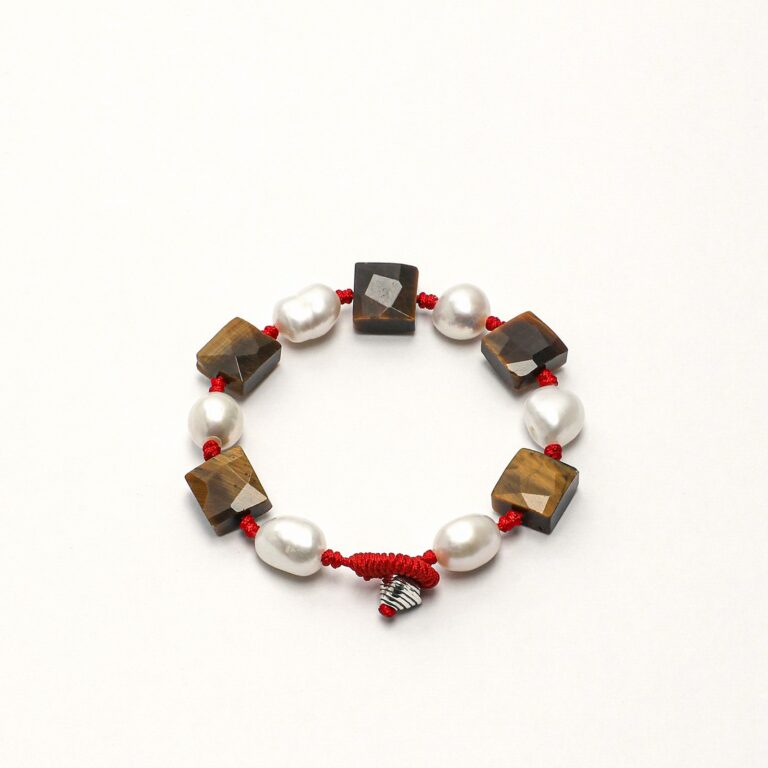
Tiger eye set against square freshwater pearls. The soft white breaks up the brown, which is how people who think tiger eye is “too earthy” end up wearing it. See this bracelet.
Picking a strand: four checks
Tiger eye is affordable, which means the market is full of mediocre strands. These four checks separate a good one.
— Move the bead, watch the band. Tilt it under a lamp. The bright line should travel smoothly across the surface, not flicker or break up. A dead patch is a bead polished past its fibre layer, or one that has weathered.
— Check for grey. Any bead with a flat, chalky grey area has lost its flash; in a good strand that bead will not be sitting on the outside of the wrist.
— Look at the stringing. Beads should sit close with no visible gaps, and the elastic should not show between them. A bracelet that arrives already gapping will gap more within a month.
— Ask about treatment. Red should be described as heated; blue should be described as hawk’s eye or dyed. A seller who cannot answer is a seller to skip.
Keeping it looking sharp
Tiger eye is tougher than most beads but not carefree. It dislikes prolonged heat — do not leave a strand on a dashboard in summer, because the fibre structure can craze — and it dislikes acids and chlorine. Take it off for the pool and for cleaning with bleach. Wash it with lukewarm water, a drop of mild soap and a soft brush, then dry it with a cloth rather than leaving it wet: water sitting in the stringing shortens the elastic’s life. Skip ultrasonic cleaners on any beaded strand — not because of the stone, but because of the string. Store it flat or in a pouch; hanging a heavy bead bracelet on a hook stretches the elastic over months.
Worn daily, expect to restring somewhere around the two-year mark. That is ordinary maintenance for any beaded bracelet, not a defect. For the wider picture on bead size and width, our bracelet collection lays out the range; the plain golden strand is the closest thing we have to a starting point.
Questions we get
Is tiger eye a real gemstone or a treated stone?
A real natural stone — quartz with parallel fibre inclusions. Golden and bronze strands are usually untreated. Red is normally heat-treated, and vivid blue is often dyed.
Can I wear it in the shower or the pool?
Better not. The stone tolerates water, but chlorine and repeated soaking shorten the life of the stringing and dull the polish over time.
Why does it flash in one spot but not another?
Because the fibre bands inside each bead sit at their own angle. The flash appears only when light hits those fibres directly, so every bead has one best side. It is normal, and it is how you know the bead is natural.
Is tiger eye good for men’s bracelets?
It is one of the most common stones in men’s beaded jewellery, largely because brown-gold reads as neutral rather than decorative. An 8–10 mm strand with matte black or brass is the standard pairing.
Do all tiger eye beads look the same?
No. Each piece is unique — banding, tone and the position of the flash vary from bead to bead and strand to strand. Photographs show one example, not the exact strand you will receive.
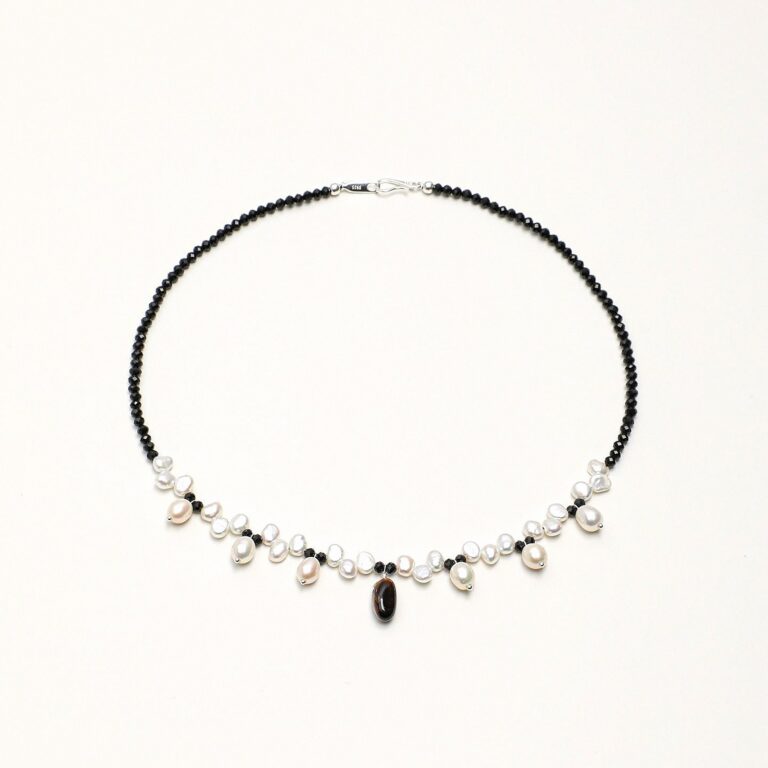
The same stone in a choker, set with black tourmaline. A bracelet, a choker and a pair of drops in one tone read as a set without looking matched. More in the tiger eye collection.
Bracelets are 17–18 cm and adjustable; wider cuffs run 14.5–18 cm. Over $75 ships free within the US. Orders go out in 3–5 business days and arrive in 7–12; returns within 30 days.