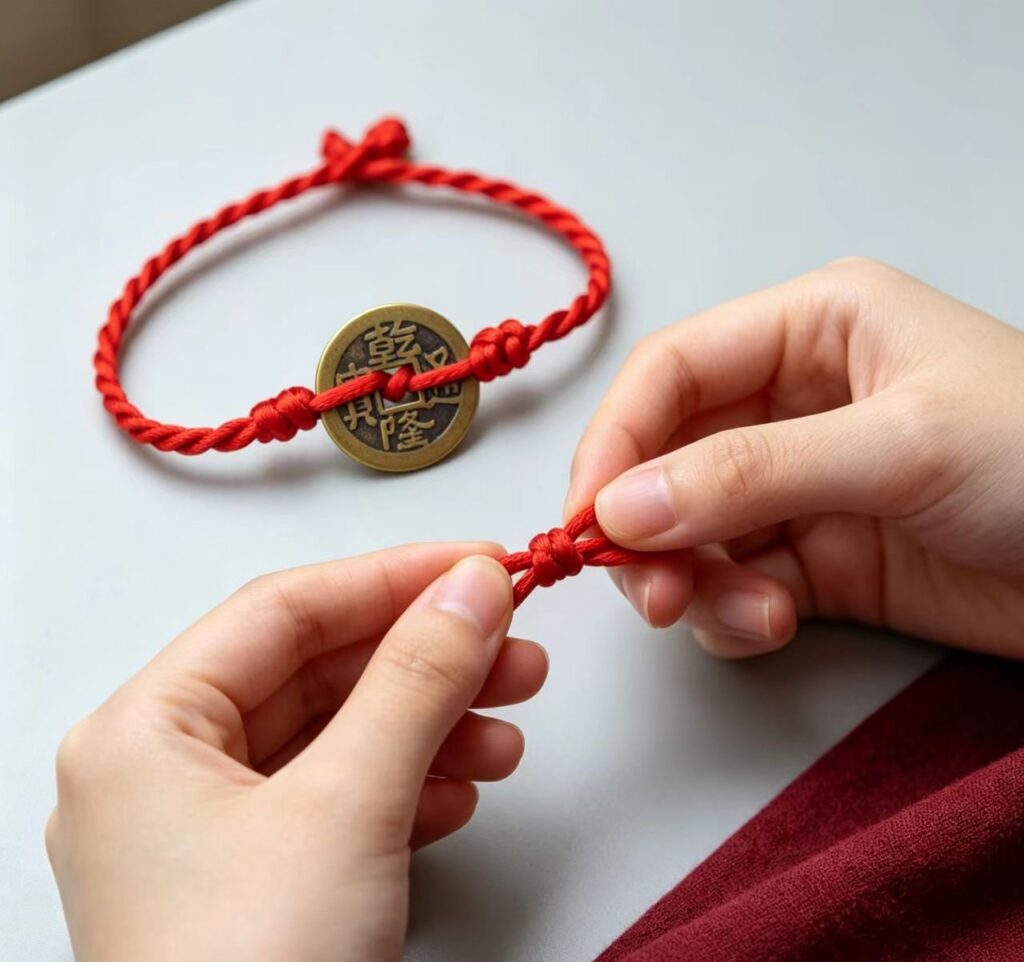
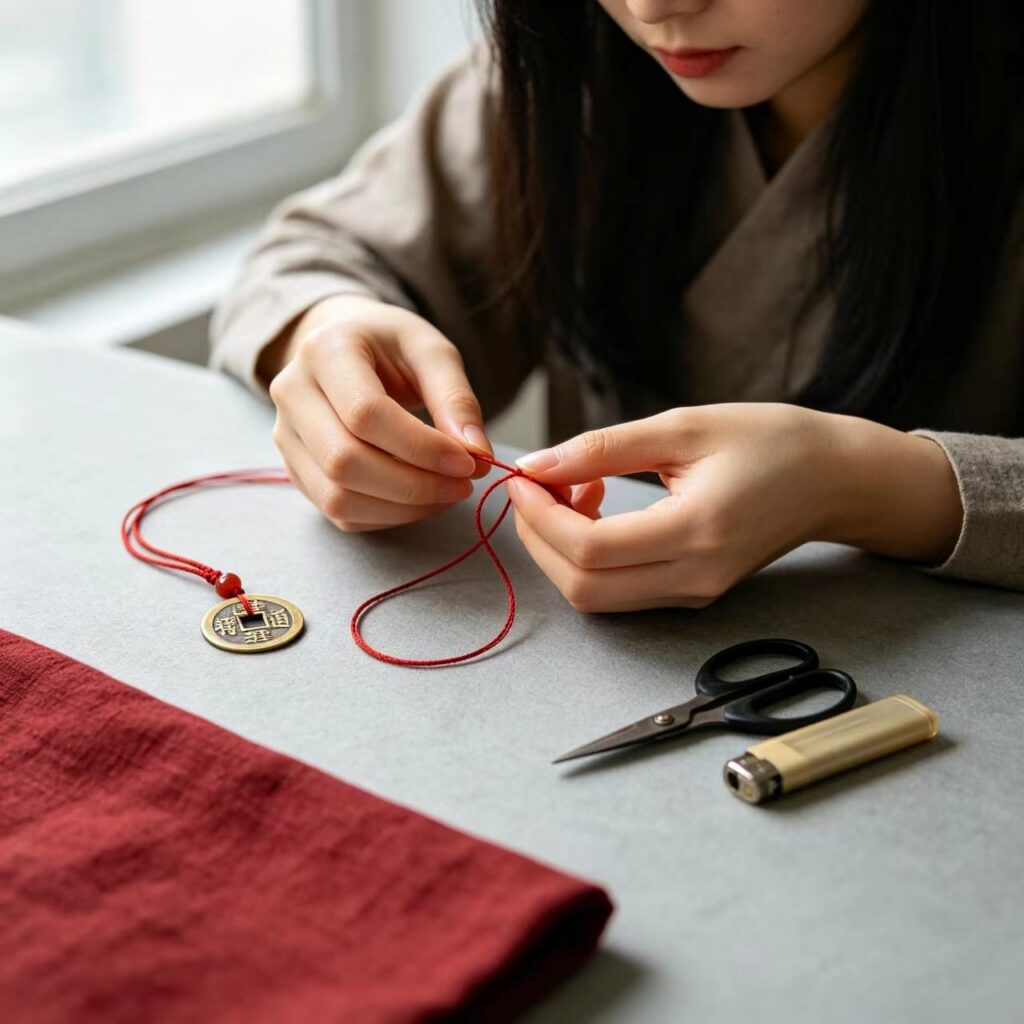
The Five Emperor Coins bracelet — Wu Di Qian in Chinese — is a cord bracelet strung with five coin-shaped charms, braided by hand in the traditional Vajra knot. The five coins refer to the reigns of five consecutive Qing dynasty emperors, a period people associate with stability and prosperity. This guide explains what the coins are, what the bracelet has traditionally meant, and how to choose a cord colour and fit that you will actually wear.
Where the five coins come from
The coins copy the issues of five Qing emperors who ruled in sequence: Shunzhi (1644–1661), Kangxi (1662–1722), Yongzheng (1723–1735), Qianlong (1736–1795) and Jiaqing (1796–1820). Nearly two centuries, one after another, without a change of dynasty — which is exactly why the set became a symbol rather than a handful of loose change.
In Chinese popular practice the five were strung together in their original order — Shunzhi first, Jiaqing last — and kept as a small charm. The reasoning was simple: five reigns of steady rule, carried in sequence, was thought to hold that steadiness in place. The order matters in the tradition; a strand in the wrong sequence is just five coins.
Original Qing coins are antiques and are collected as such. Almost everything sold as a Five Emperor Coins bracelet today, including ours, uses modern brass coins with an antique finish, cast in the traditional shape and strung in the correct order. We say this plainly because a bracelet at this price is not selling you a 300-year-old coin, and any seller who implies otherwise is not being straight with you.
What people traditionally did with them
The charm was rarely worn as jewellery in the way we wear it now. Common uses were: hung at the entrance of a home, placed under a doormat, kept in a wallet or a bag, tied to a child’s wrist, or hung in a car. The intent was protective — a boundary object, kept between the household and whatever was outside it.
Wearing it on the wrist is the modern adaptation, and it is a good one: a coin bracelet is visible, tactile, and easier to keep on than a charm in a drawer. What it is not is a guarantee. The tradition says protection and prosperity; it does not promise either. We describe the meaning because it is the reason the object exists and the reason people ask for it — not because a bracelet changes your bank balance.
What our bracelet actually is
Five brass coins with an antique finish, braided onto a nylon cord by hand, in the traditional Vajra knot. The cord ends are heat-sealed so they do not fray — a standard finishing step, and the reason you may see a slight mark at the very end of the cord. It is not a defect and it does not affect wear.
Each bracelet adjusts from 16 to 26 cm by pulling the two cord ends, so one size covers most wrists and also works as an anklet. Because every piece is braided by hand, the knot tension varies slightly from bracelet to bracelet. We make it in 13 cord colours, which is unusual for this kind of charm and the main reason people buy more than one.
Choosing a cord colour
The colour is not only aesthetic. In the five-element framing that accompanies this tradition — Wood, Fire, Earth, Metal, Water — each colour group is tied to an element and, through it, to a quality people want to keep close. Take it as cultural language rather than instruction: the useful question is which of these you want to look at every day.
| Cord colour | Element | Traditionally associated with | Good for |
|---|---|---|---|
| Black, Navy Blue | Water | Steady progress, career calm | Office, everyday, unisex |
| Forest Green, Olive Green | Wood | Growth, renewal | Spring palettes, casual |
| Red String, Burgundy, Peach Pink | Fire | Protection, celebration | Gifts, New Year, weddings |
| Earth Yellow, Khaki | Earth | Stability, grounding | Neutral wardrobes, autumn |
| Silver Grey, Dusty Blue | Metal | Clarity, precision | Minimal style, silver jewellery wearers |
| Deep Purple, Grey Purple | — | Balance | Anyone who wants something less common |
If you are buying your first one, black or red string are the two safest choices — black disappears into almost any outfit, and red is the colour most associated with the charm in the first place. If you already own one, the two-tone neutrals (silver grey, dusty blue) photograph well and read as more modern than the classic red.
See the black cord, red string, silver grey, forest green.
Fit, and how to adjust it
Pull the two cord ends apart to loosen, and pull them in opposite directions to tighten. The sliding knot holds anywhere between 16 and 26 cm. For a wrist, set it so the bracelet can roll about a centimetre but cannot slide over your hand. For an anklet, set it slightly looser than you think you need — ankles swell through the day.
One practical note: brass coins are heavier than beads. A coin bracelet sits differently from a beaded one and will rotate to the underside of your wrist as you move. That is normal, and it is why the cord needs to be snug rather than loose.
Care
The nylon cord can get wet — you do not need to remove the bracelet to wash your hands. The coins are the part that needs attention.
Four habits
— Keep perfume, lotion and hand sanitiser off the brass. They speed up the patina and can leave dull spots.
— Dry the coins with a soft cloth after they get wet, especially after swimming or a workout.
— Expect the brass to darken. Brass develops a warm brown patina over time; some people want that, some do not. A gentle wipe with a dry cloth keeps it brighter without stripping the finish.
— Store it flat, away from other metal. A small pouch is enough — the point is to stop the coins knocking against harder pieces.
Questions we get
Are these real Qing dynasty coins?
No. They are modern brass coins with an antique finish, cast in the traditional shape and strung in the correct imperial order. Original coins are antiques and are priced as antiques.
Which wrist should I wear it on?
Traditionally the left. In practice, whichever wrist is comfortable and does not interfere with a watch. Many people wear it on the opposite wrist from their watch so the two do not scratch.
Can I shower with it?
Yes, the nylon cord is water-friendly. Dry the brass afterwards. Avoid long exposure to chlorine, which dulls the finish faster than plain water.
Will the coins turn my skin green?
Brass can leave a faint mark on some skin types, especially in summer. It washes off. If you are sensitive, keep it dry and avoid wearing it against damp skin for long periods.
Does it really bring protection or wealth?
That is the tradition around the five coins, not a promise. We sell the object and the craft; what you make of the meaning is yours.
How do I choose between 13 colours?
Start from your wardrobe, not from the element chart. If your clothes are dark, black or navy disappears and looks expensive. If you wear a lot of white and cream, red string or earth yellow reads as deliberate. Silver grey suits people who already wear silver jewellery.